Policart anvil covers reviewed: why we run them on our rotary die-cutter
A review of Policart's boltless, metal-free anvil covers for rotary die-cutting: what they do, what sets them apart, and why we run them on our corrugated line.
By Tradepack ·
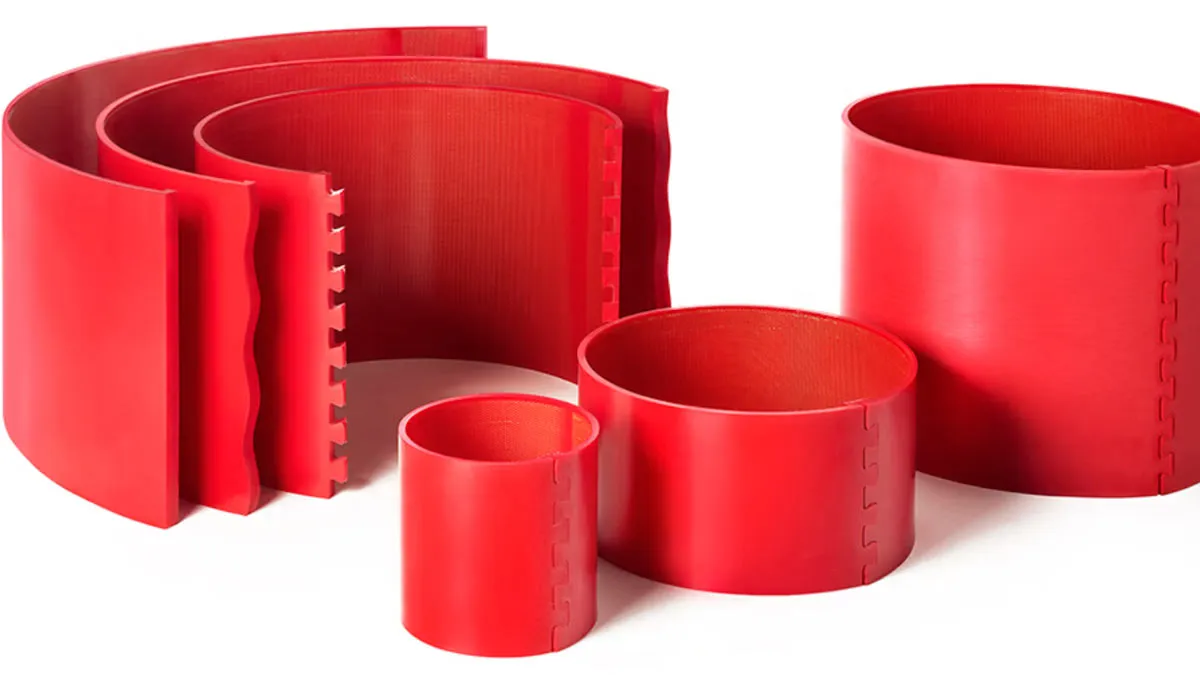
Our mailers, book wraps and shelf ready trays are cut on a rotary die-cutter. The cutting die gets most of the attention, but the surface it cuts against matters just as much. That surface is the anvil cover, and on our line it comes from Policart.
This is a look at what anvil covers do, what Policart’s are like, and why they suit a single-pass corrugated line like ours.
What an anvil cover does
A rotary die-cutter has two cylinders turning together. One carries the cutting die: a curved wooden base holding the steel rules that cut, crease and perforate the board. The other is the anvil cylinder, wrapped in a replaceable urethane cover. As each sheet passes between them, every rule presses through the board and into that cover.
The cover has a demanding job. It has to be firm enough to give a clean cut, resilient enough to recover from constant impact, and even enough that every rule cuts to the same depth. Because the die strikes the same positions on every rotation, wear concentrates in the same places. Covers are rotated and moved along the cylinder to spread that wear, and ground back to a flat surface when they need it.
When a cover is worn, it shows in the product: ragged edges, fibre tails along cut lines, perforations that do not fully separate, and trim that clings to the blank instead of dropping clear.
About Policart
Policart was founded in 1998 and is based in Castiglione Olona, in northern Italy between Milan and the Swiss border. It makes consumables for the corrugated industry, including die-cutting blankets, anti-crush wheels, creasing profiles, anvil covers and other urethane components, and supplies customers in more than 60 countries. It works to an ISO 9001:2015 quality management system. Its covers are a distinctive red, which gives the company its tagline: the only red you can trust.
What sets Policart’s anvil covers apart
These are the features Policart highlights for its rotary anvil covers:
- Boltless mounting. A finger-lock locking section holds the cover without bolts, so it fits quickly and can be mounted at any position along the die-cutting cylinder.
- Metal-free construction. There are no metal parts at all: a fibreglass backing and a polyurethane compound.
- A tight, interlocking fit. The joint interlocks to keep the cover firmly seated, with a jigsaw-style joint available for easier fitting.
- A wide range of sizes. Standard, double and custom widths, in hundreds of diameters to suit different machines.
- Long life and easy resurfacing. The compound is designed to resist wear, gives a good surface to crease against, and is easy to grind back to flat.
Policart reports that customers see better trim waste ejection, higher machine speeds, cleaner perforation and less downtime spent rotating covers. Those are the manufacturer’s claims, but they are exactly the things a converting line should be aiming for.
Why we run them on our line
Our line prints, cuts, glues, applies peel and seal and palletises in a single pass. That shapes what we need from an anvil cover.
Short stops. On a single-pass line, any stop halts every process at once. Covers that fit and rotate without bolts keep routine maintenance short.
Trim that clears. Waste has to drop cleanly away from the blanks before they are counted and palletised. Cutting against an even surface helps the trim eject rather than hang on.
Perforations that work. Tear strips on peel and seal packs, and the tear-away fronts on shelf ready packaging, depend on clean, consistent perforation. A worn or uneven anvil surface is one of the first things to show up there.
Consistency across repeat runs. Most of what we make is supplied run after run to the same specification. A cutting surface that wears slowly and can be resurfaced helps the thousandth pallet match the first.
What it means for the packaging you buy
None of this appears on a quote, but it shows in the product: clean edges, perforations that tear where they should, and blanks free of stray trim that erect cleanly on the packing bench. It also supports what matters most to trade buyers: a line that keeps running, and lead times that hold.
See corrugated conversion and finishing for more on how our line works, or request a quote for your next format.