Cardboard trays for drinks: stacking, handling and retail-ready formats
Corrugated tray formats for cans and bottles: tray and hood, shrink-ready trays, hand holes, dividers, stacking strength and print for retail display.
By Tradepack ·
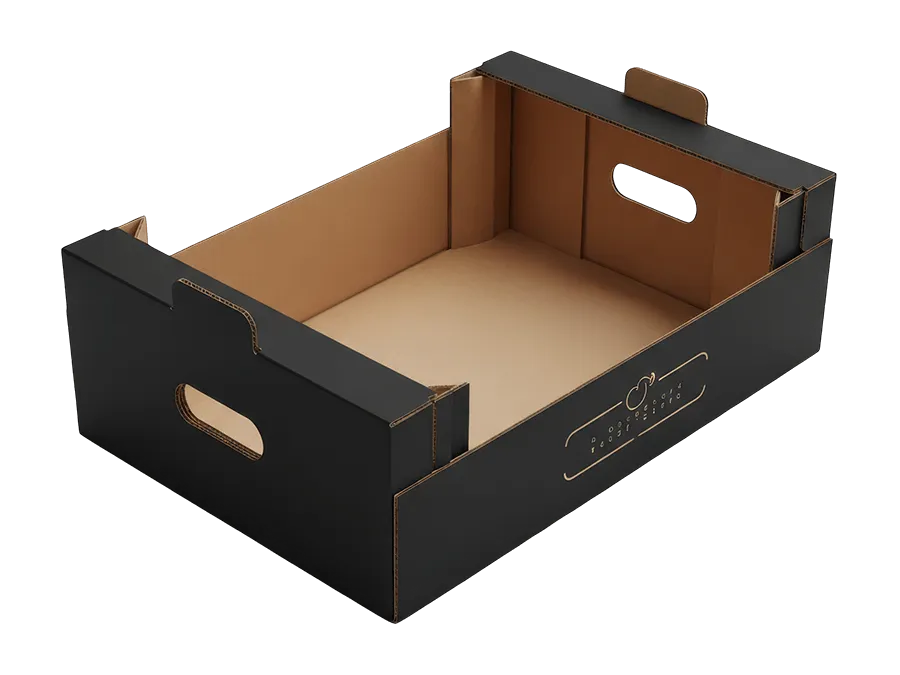
Trays do unglamorous work. They hold cans and bottles together through a distribution network, take a shrink wrap or a hood for transit, then either go on a shelf as they are or get opened and emptied. Because they look simple, they are often specified casually, and the two things that go wrong with them, collapsing under a stack and letting glass move, are both expensive.
This is a guide to the tray formats used for drinks and the decisions that actually matter when you specify one.
The formats
Open tray, shrink-wrapped. The workhorse of canned drinks. A die-cut tray with a low wall, filled with cans and shrink-wrapped for transit. The wrap holds the pack together and the tray carries the stack. Cheap, fast to fill and easy to stack, but the pack depends on the wrap, and the print is partly obscured by it.
Tray and hood. A two-piece pack: a tray that holds the product and a separate hood that fits over it. The hood carries the transit print and comes off in store, leaving a tray that goes straight on shelf. Strong, tidy and popular for shelf ready packaging, at a higher unit cost than a wrapped tray because there are two pieces of board.
Tray with a tear-away front. One piece, die-cut with a perforation so the front panel or an upper section is removed in store. It arrives as a closed case and becomes a display tray in one motion. Our guide to what retailers require from a case covers the opening, stacking and disposal rules these packs are judged against.
Deep tray with dividers. For glass. A deeper tray, usually double wall, with die-cut dividers or a fitment that keeps each bottle clear of its neighbours. This is closer to a transit case than a display pack, and it is the format most often used for wholesale distribution of bottled drinks.
Carrier trays. A tray with an integral handle or hand holes, designed to be picked up and carried by the shopper. Where the pack is being sold as a multipack in its own right rather than as transit packaging, it starts to overlap with the formats in our guide to bottle carriers.
Cans and bottles are different problems
Cans are strong in compression and tolerate touching each other. They carry much of the stack load themselves, which means a lighter tray can often do the job, and dividers are rarely needed. The risks are lateral movement in a loose pack and denting at the rim.
Glass is heavy, fragile and unforgiving of contact. Bottle-to-bottle knocks break bottles and scuff labels, which is a rejection at goods-in even when nothing has broken. Glass needs to be held clear on all sides, and the tray has to carry the whole weight of the stack because the bottles will not do it reliably, especially if there is any shoulder taper.
Weight is the other constraint. A tray of bottles gets heavy quickly, and there is a practical limit to what a person should lift off a pallet repeatedly. That limit, not the board, often sets the pack count.
Stacking is the thing that fails
Trays are stacked: in the cage, on the pallet, and often on the shelf. Compression, not drop, is what usually defeats them.
Three things decide how a tray carries a stack. Board grade and flute profile give it the raw strength. Tray depth and wall height determine how much of the load is carried by the walls rather than the product. And how the trays are aligned on the pallet decides whether that strength is actually used: corner-to-corner is where the compression strength lives, so a column stack carries far more than a bonded pattern that puts weight in the middle of the panels below.
Humidity matters as well. Board loses compression strength as it takes up moisture, which is why a tray specified for a dry warehouse can fail in chilled distribution with the same product in it. If the pack is going anywhere cold or damp, say so at the specification stage. Barrier-coated boards exist, but wax and polyethylene coatings cause problems at the paper mill, so it is worth reading our note on what keeps a pack recyclable before committing to one.
Hand holes, lips and the details that decide acceptance
- Hand holes make a heavy tray liftable and stop handlers gripping the product. They are die-cut, so they cost nothing per unit once the forme exists, but they remove board from the wall and have to be positioned where they do not weaken the corner posts.
- Front lip height is the usual argument on display trays. High enough to hold the product in during transit, low enough that a shopper can see and reach it. A quarter to a third of the product height is a common starting point, then settled on sample.
- Dividers and pads. Die-cut inserts keep glass apart and can add usable compression strength where they run corner to corner. A base pad protects against grit and spreads point loads.
- Perforations. A tear line that opens cleanly in one motion, without tearing into the tray or catching on the product, is worth sampling with real product rather than approving from a drawing.
Two colours on kraft or white liner covers the work most trays need to do: brand identification on the shelf-facing panel, product and variant identification for the person filling the shelf, and any handling or stacking marks. We print inline, Pantone matched, on the same pass as cutting and gluing, so there is no separate print stage or lead time. Where a tray needs photographic imagery or a premium finish, digital, four-colour flexo and litho-lamination are available through our print partners.
Specifying one
Give us the product dimensions and weight, the pack count, whether the pack is wrapped, hooded or closed, how high the trays stack and in what pattern, and where the pack is stored and distributed, including chilled. We will design the tray on CAD, cut samples on the digital flatbed so you can fill them with real product and stack them before tooling is ordered, then manufacture in pallet quantities on a single pass.
See our drinks packaging page for the formats we make, or send us the details and we will quote.