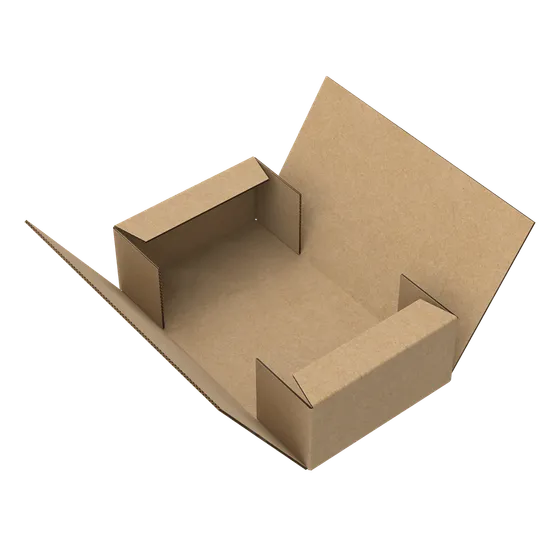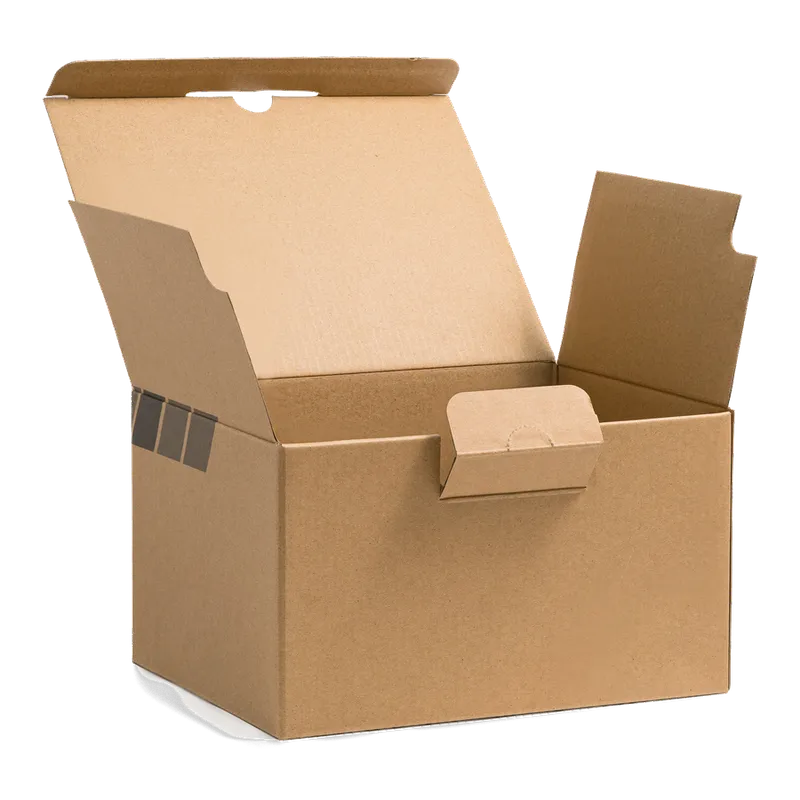
A crash-lock box arrives flat and becomes a box in one movement. The base flaps are die-cut and glued so they lock together as the blank is squared up, which means no folding four flaps, no reaching for the tape gun and no taped seam to fail under load.
Where the saving is
The format is bought for labour, not for board. On a bench running hundreds of packs a day, the seconds spent assembling and taping a base are the largest avoidable cost in the process, and a crash-lock base removes them.
The trade-off is real and worth stating: the blank is larger than a plain slotted case, it is die-cut rather than slotted, and it carries more glue, so the unit price is higher. Whether that pays back is arithmetic rather than opinion, and our article on when a crash-lock base pays for itself sets out how to work it out from your own pack rate.
Board and sizes
Board is specified to the use case rather than from a fixed list. E flute suits lighter retail and e-commerce packs where print quality and a slim profile matter, B and C flute cover the bulk of transit work, and BC double wall handles heavy contents or packs stacked several high. Other grades are available where the application calls for them.
Every size is made to the internal dimensions the product needs, which keeps the pack tight and removes the void fill a nearest-stock-size box would need. Tooling is a one-off for each design and is retained for repeat runs, so only the first order carries it.
Print and closures
Up to two-colour flexographic print, Pantone matched, is applied inline on the same pass as cutting, creasing and gluing. Printing the inside of the lid is common for e-commerce packs where the opening matters.
The lid can be specified as a tuck-front, taped, or closed with an inline peel and seal strip. Adding a second strip and a tear perforation gives a pack that the customer can open cleanly and reseal for a return, which is why the format is popular with apparel and subscription programmes.
Manufactured in one pass
Crash-lock cases run on our rotary die-cutting line, where print, cutting, creasing and multi-point gluing happen in a single pass before automatic palletisation. Cut samples come off the digital flatbed first, so you can square one up and pack real product into it before any tooling is ordered. See custom die-cut packaging for the wider range of die-cut formats, or send us the product details for a quotation.