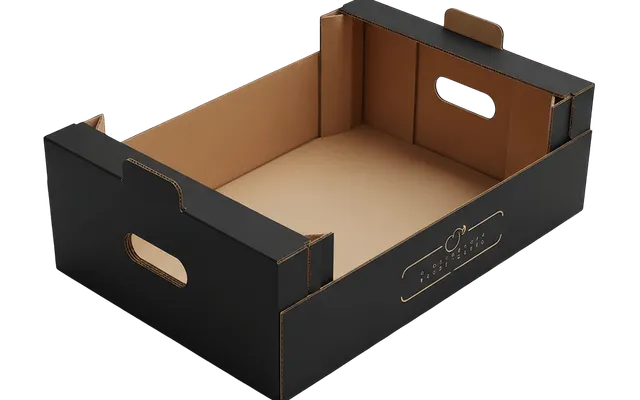
Crash-lock boxes: when an auto-lock base pays for itself on the bench
How a crash-lock base differs from a taped case, where the labour saving is real, where it is not, and how to work out the answer for your own line.
By Tradepack ·

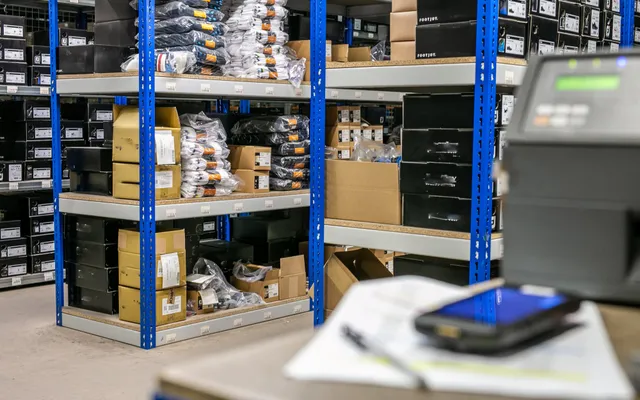
Most packing benches start the same way: someone picks up a flat case, squares it up, folds four flaps, and runs a strip of tape along the join. It takes a few seconds and nobody thinks about it. Multiply those few seconds by the number of parcels going out each day, though, and the base of the box becomes a real line on the cost sheet.
A crash-lock base removes that step. The base panels are glued during manufacture so they interlock as the box is opened out: squeeze the flat case into shape and the base locks itself, ready to fill. These self-erecting boxes need no tape, no folding sequence and no training.
How it differs from the alternatives
Against a taped case. A standard slotted case such as the 0201 needs its base flaps folded and taped. A crash-lock case needs neither. The trade-off is that the crash-lock blank is larger, is die-cut rather than simply slotted, and carries more glue, so it costs more per box.
Against a tuck-bottom. A tuck-in base needs no glue, but it has to be assembled by hand, panel by panel, and it is the weakest of the three under load. Crash-lock gives you speed and strength together.
Against a one-piece mailer. Die-cut mailers such as the 0427 also erect without tape, but they are a different animal: a hinged lid, a tuck-front closure and a shallower profile. Crash-lock suits deeper cases where the contents go in from above.
Where it pays
The saving is labour, so it scales with throughput and with how hard people are to find.
- High parcel volumes. The more boxes per shift, the more seconds saved become hours.
- Seasonal peaks. Crash-lock takes assembly skill out of the job, which matters when the bench is full of temporary staff in November.
- Multiple sites or agency labour. A base that cannot be assembled wrongly gives consistent results wherever it is packed.
- Awkward benches. Where there is no room for a case erector, crash-lock gets some of the same benefit without the machine.
- Heavier contents. A glued, interlocked base carries load better than a tucked one.
Where it does not
- Low volumes. If you ship tens of parcels a day rather than hundreds, the labour saving will not repay the extra unit cost.
- Very heavy or dense loads. Crash-lock is strong, but past a certain weight the honest answer is a taped or stitched base in a heavier board.
- Tight budgets on a simple transit case. If the box is going onto a pallet in bulk and nobody is racing the clock, a plain slotted case is the cheaper answer.
- Very small runs. The die-cut tooling has to be justified by the volume.
Working out the answer for yourself
Do not take a supplier’s word for the saving, including ours. Measure it:
- Time the current job. Take a stopwatch to the bench and time ten boxes from flat blank to filled and closed. Take the average of the base assembly portion.
- Time a crash-lock sample doing the same thing. Ask for samples before committing; we produce them as a matter of course.
- Take the difference in seconds and multiply by the number of boxes you pack in a year.
- Convert to hours and apply your labour rate, including the on-costs.
- Compare that with the extra pence per box across the same annual volume.
If the labour figure is comfortably larger, crash-lock pays. If it is close, it probably is not worth the change, though there may still be a case on consistency and training.
Specifying one
A few details decide whether a crash-lock case performs:
- Board grade. The base takes the load, so grade is chosen from the filled weight and the drop height. Our guide to board grades covers the options.
- Glue pattern. The base relies on glued joints doing their job every time. Our multi-point glue system lays down a controlled pattern so the lock closes cleanly without squeeze-out.
- Flute direction. Set so the walls carry stacking load rather than the base seams.
- Top closure. Tape, tuck, or a peel and seal strip if you want to take a second step out of the pack as well.
- Pallet configuration. Crash-lock blanks are bulkier than slotted blanks of the same internal size, so check how many land on a pallet and what that does to storage and delivery.
Getting a sample
The only reliable test is your own product on your own bench. Send us the internal dimensions, the filled weight and how the box is packed, and we will design a crash-lock case, cut a sample and let you time it. Request a quote or see our crash-lock boxes page for how the format is manufactured.