Bottle carriers for drinks brands: formats, board and print for retail and multipacks
The main cardboard bottle carrier formats, carton board versus corrugated for glass, the details that stop handles tearing, and how to brief one.
By Tradepack ·
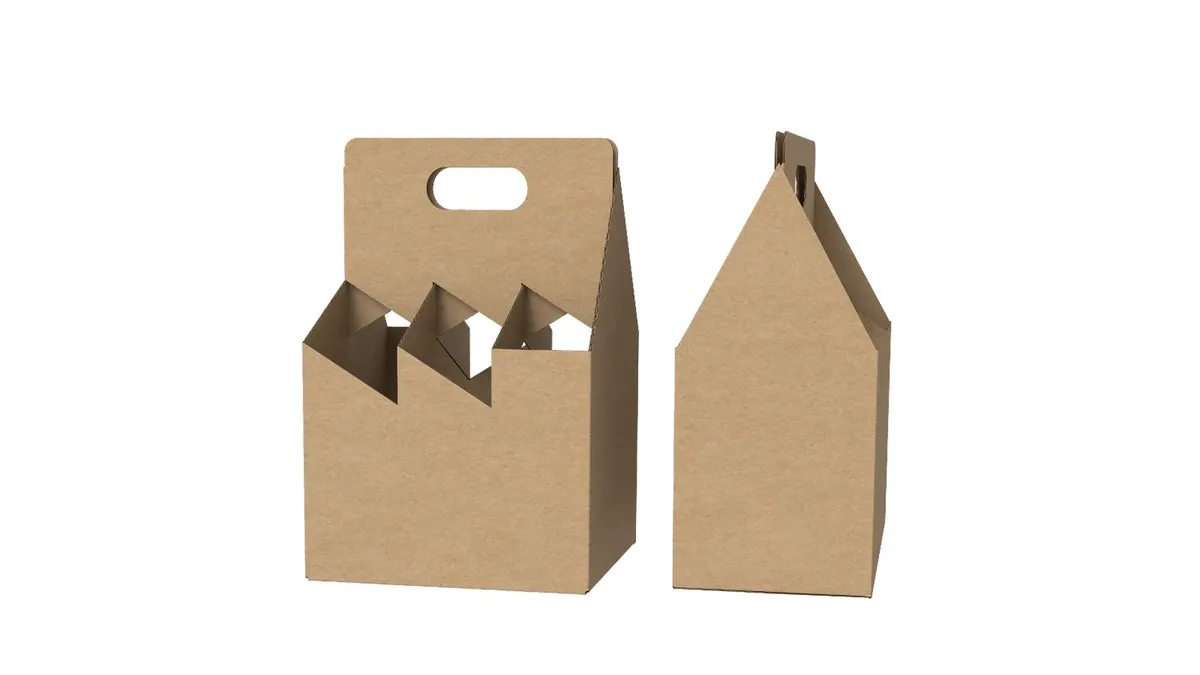
The carrier is often the first part of a drinks brand a shopper actually holds. It turns single bottles into a multipack, puts the brand on the shelf at eye level, and gets heavy glass home without a bag. For craft breweries, cideries, distillers and wine brands selling through retail, farm shops, taprooms and gifting, a well-made carrier does a lot of commercial work for a small piece of board.
Here is how the main formats differ, what the board needs to do, and the design details that decide whether a carrier holds up.
The main carrier formats
Basket carriers. An open-top carrier with a divider cell for each bottle and a handle rising from the central partition. This is the classic four- and six-bottle format for beer and cider. The bottles and their labels stay visible, and the carrier folds flat for supply.
Enclosed carriers. Closed sides and top with a handle, sometimes with a gable or peaked top. They protect the bottles, keep labels out of sight until opened, and give a full surface for print. They suit premium ranges, gifting and packs that travel further.
Wrap-around and sleeve carriers. Board wraps around the bottles or cans and locks at the base. They use the least board and are common for cans and high-volume multipacks, but they give less protection to glass.
Two- and three-bottle carriers. Tall carriers with a handle for wine and spirits bottles, often used for gifting, cellar door and retail sales.
Carton board or corrugated
Most carriers are made from one of two materials, and the right one depends on the product and how it is packed.
Carton board is the usual choice for very high-volume multipacks run through automated packing lines, where the packs are light and the speeds are high.
Corrugated board is the stronger option for glass. It resists puncture, holds its shape under load, and copes better with heavier bottles and larger counts. E flute is the common choice for carriers because it folds cleanly, gives a good print surface and is strong for its thickness. Our guide to corrugated board grades explains the flute and paper options in more detail.
Tradepack manufactures corrugated carriers, which suit craft, premium, gifting and retail ranges that are packed by hand or in moderate volumes.
Designing for glass
Glass is heavy and fragile, and a carrier has to cope with both. These are the details that matter.
- Weight. Six full bottles weigh several kilograms, and all of it hangs from the handle. The design starts from the filled weight, not the empty bottle.
- The handle. The handle cut-out is the most likely point of failure. Common approaches are doubling the board through the handle panel, rounding the corners of the cut-out so a tear has nowhere to start, and making sure the flutes run in the direction that carries the load.
- Dividers. Cells keep bottles apart, which stops them clinking, chipping and scuffing labels. Full-height dividers give the most protection; shorter dividers save board where bottles are sturdy.
- The base. The base carries the weight when the carrier is set down and supports the handle when it is lifted. A locking base that erects quickly also saves time on the packing bench.
- Bottle fit. Bottles of the same nominal size vary between brands in height, diameter, shoulder and neck. Carriers are designed around the actual bottle, with enough clearance to load quickly but not so much that bottles rattle.
- Chilled and damp conditions. Condensation softens board. If carriers will sit in fridges or chillers, the board grade and handle design need to allow for it.
Print and shelf presence
A carrier is prime brand space: the side panels, the handle panel and, on enclosed carriers, the top. Flexographic print with matched Pantone references keeps brand colours consistent across repeat runs. A kraft face gives a natural, craft look; a white or mottled white liner makes colours brighter and suits more vivid artwork. Our flexographic printing page covers what suits the process.
Retail details matter too: where the barcode sits, how the carrier looks from the aisle, and whether it fits the shelf or chiller it is destined for.
An alternative to plastic
Corrugated carriers give drinks brands a way to sell multipacks without plastic rings or shrink film. Corrugated board is collected in kerbside and commercial paper streams across the UK, which makes it a straightforward choice for brands and retailers reducing plastic in their packaging.
Briefing a carrier
A carrier can be designed accurately first time with this information:
- The bottle. Type and size, ideally with exact dimensions, or better still a sample bottle.
- The count. How many bottles per carrier.
- The filled weight of one bottle.
- How it is packed. By hand, or on a machine. If a machine is involved, say so at the start, because automated lines have their own requirements.
- Where it will be sold and stored, including whether it will be chilled.
- Print and artwork, with any Pantone references.
- Quantities and how they will be called off.
How we help
We design carriers in CAD around your actual bottle, cut a sample, and test it with filled bottles for handle strength and drops before any tooling is ordered. See our drinks packaging page for the full range of drinks formats, or request a quote with your bottle details and we will come back with a design and a price.