
Wholesale cardboard boxes: stocking a range that actually sells through
How to build a wholesale corrugated range that turns over: which sizes earn space, where stock ties up cash, and when to stop stocking and start specifying.
By Tradepack ·
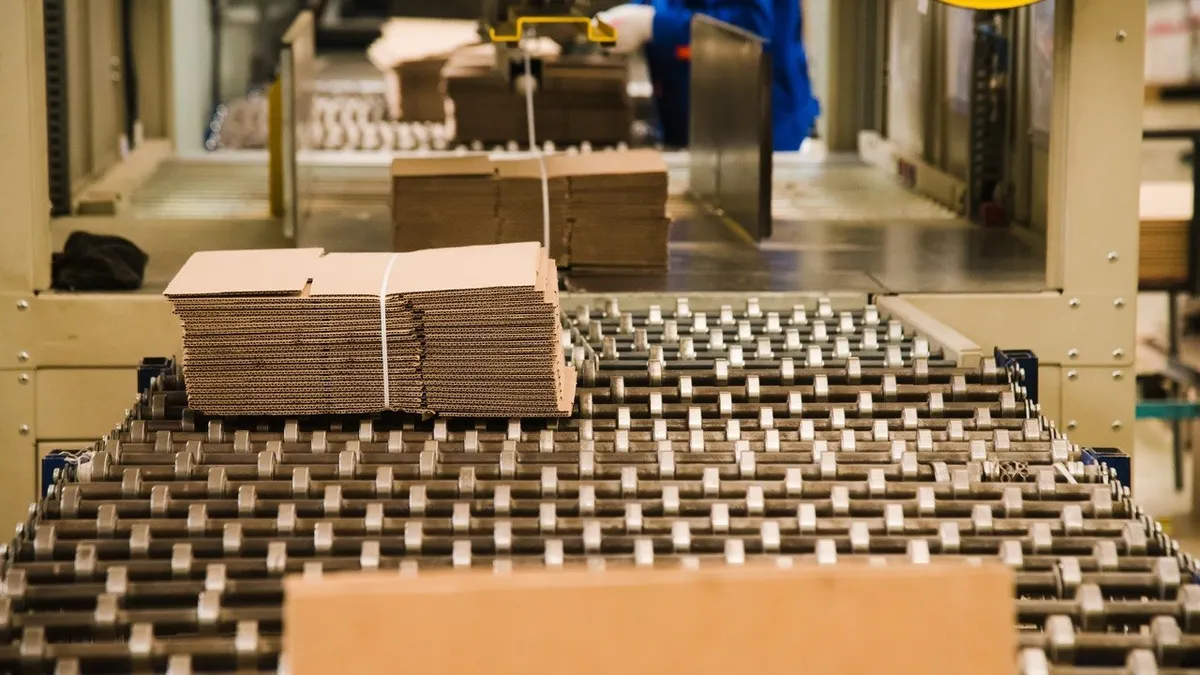
Every packaging distributor has a stock range, and most have one that grew rather than one that was designed. A line gets added for a customer who then changes supplier, a size gets duplicated because nobody checked, and five years later there is racking full of board that nobody has ordered since spring.
The range is a product in its own right. It is worth building like one.
The shape of the problem
Pull twelve months of sales and rank every line by value. The shape is almost always the same: a small group of sizes carrying most of the turnover, a middle that justifies itself, and a long tail that does not.
The tail is not free. Each slow line occupies a pallet space, holds working capital, and gets counted, picked round and eventually written off. It also makes the fast lines harder to manage, because every extra SKU is another thing to forecast, reorder and get wrong.
Cutting it is uncomfortable, because each line has a customer attached. The question is not whether the line sells. It is whether it sells enough to justify holding it rather than quoting it on a lead time.
What earns a place in stock
Three tests, and a line should pass all three.
It covers breadth. A size that fits a spread of products beats one tuned to a single item. The 0201 case is the classic example: one construction, a hundred applications.
It suits more than one customer. A line that exists because of one account is that account’s stock, not yours, and should be funded accordingly through a call-off programme rather than speculative holding.
It is not about to go obsolete. Sizes pinned to a carrier’s pricing bands are the obvious risk. Carriers move those bands, and a range built tightly around the current ones ages overnight. Our piece on sizing to carrier bands covers which dimensions are worth designing around.
Breadth without depth
The commonest range error is too many sizes too close together. Three mailers within 20 mm of each other do not serve customers better; they split the same demand three ways, triple the stockholding and make every reorder smaller and dearer.
A range with clear steps between sizes sells better than a dense one. The gaps do real work: they push a customer to the next size up, which is usually the right answer anyway, and they keep each line’s turn high enough to buy well.
Where the gaps genuinely do not work for a customer, that is the signal to specify rather than to stock. A box made to their dimensions in a call-off programme is cheaper for everyone than a new stock line nobody else buys.
Stock, or lead time
The honest framing is cash and turn rather than unit price.
A stock line bought at a keen price and turned four times a year is working. The same line turned once is a loan to your own warehouse. Add racking, capital, counting and the risk that the spec changes before the pallet clears, and a made-to-order box at a higher unit price is often the cheaper option.
So split the range deliberately:
- Stocked — fast, broad, multi-customer lines where availability is the selling point.
- Programmed — customer-specific formats on a call-off schedule, manufactured to a locked specification and drawn down against a forecast.
- Quoted — everything else, on a lead time, priced when it is asked for.
Most ranges have far too much in the first bucket and almost nothing in the second.
Where the margin actually comes from
Plain stock boxes are a price comparison. Anyone can quote a brown 0201, and the customer can check it in a minute.
The lines that hold margin are the ones with something in them that is not a commodity: a format cut to the product, a print, a closure that saves time at the customer’s bench, or a programme that guarantees availability. Our guide to what drives the unit price sets out where cost sits in a bespoke box, which is the same information you need to price one confidently.
A peel and seal closure is the clearest example. It adds a small amount to the unit cost and takes a tape gun, an operation and a quality variable out of the customer’s packing line, which is a conversation about their throughput rather than about your price per box.
Buying it well
Corrugated is bought by the pallet and made in runs, so the way a range is bought matters as much as what is in it.
Consolidating a year’s requirement for a line into scheduled call-offs buys better than ordering it four times reactively, and it holds the specification steady between runs. Grouping formats that share a board grade helps too, because board sourcing is planned rather than improvised.
We manufacture trade only, behind distributors’ own ranges and own branding. The practical consequence is that the range stays yours: we do not sell to your customers, and we do not appear in front of them unless you want us to. Delivery can go to your warehouse or straight to your customer’s site, palletised and labelled as you specify.
A review worth doing annually
Once a year, four questions:
- Which lines turned fewer than twice? They are candidates for quoting rather than stocking.
- Which sizes sit within 20 mm of each other? One of them should go.
- Which lines exist for one customer? They belong in a programme.
- Which specifications have not been looked at since they were set? Board grades drift upward over the years, and a review against the actual load usually takes weight and cost out.
Send us the range — the sizes, the grades and the annual volumes — and we will come back with where it can be consolidated, what it costs to manufacture, and which lines are better run as a programme than held on racking.