Crosland Cutters reviewed: the tooling behind every die-cut box
The forme is where a CAD drawing becomes a physical tool. What goes into one, what rule height and point thickness decide, and why tooling sets the lead time.
By Tradepack ·
A packaging design is a drawing until somebody turns it into a tool. Everything before that point is reversible and cheap. Everything after it is steel, plywood and a purchase order.
That conversion happens at a die shop, and ours is Crosland Cutters.

Crosland Cutters is based at Nimmings Road in Halesowen, West Midlands, and describes itself as one of the longest-established cutting forme manufacturers in the UK. Multi-piece formes joined the range in 1967, and Harry Rose acquired the business in 1972.
What a forme is doing
We have written before about whether a forme is worth committing to. This is about what one actually is.
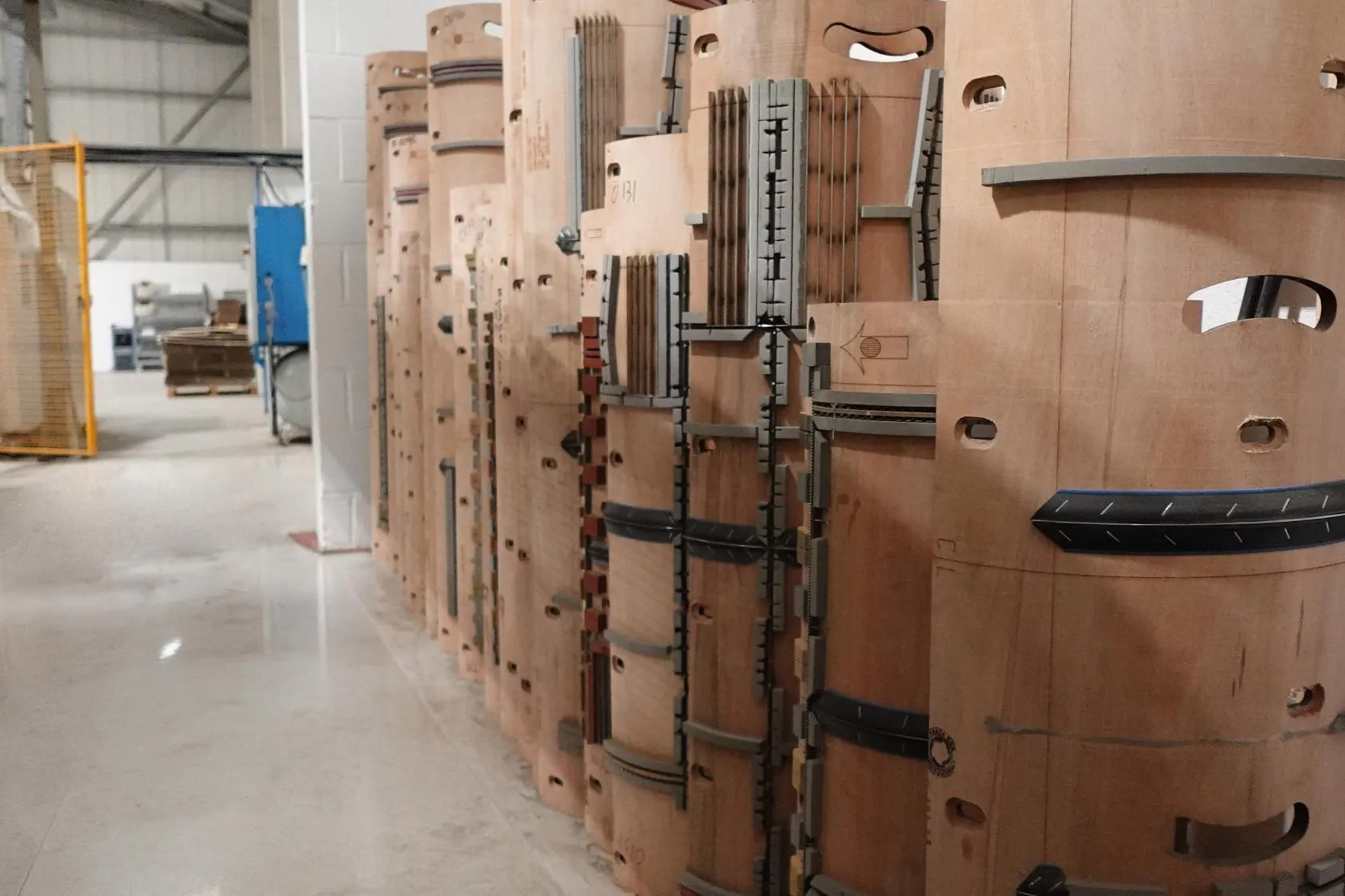
A cutting forme is a sheet of plywood with slots cut into it and steel rule set into those slots. Sharp knife rule where the blank is cut out, blunter creasing rule where it has to fold, and rubber ejection either side to push the board clear once it has been through.
Everything about how a finished box behaves traces back to that object. Whether a crease folds crisply or cracks, whether a cut edge is clean or furred, whether a locking tab engages: all decided by the position, height and profile of rule set into a board by someone in Halesowen.
Rule height and point thickness
The two numbers that do most of the work.
Height is how far the rule stands proud of the board, and it has to suit the calliper of what is being cut. Crosland stock most heights from 23.30 to 80 mm. Single wall E flute and double wall BC are very different thicknesses, and a forme set for one will not do a competent job on the other.
Point thickness — 2, 3 or 4 point in their stock range — is the thickness of the rule itself. On creasing rule it decides the width of the crease, which decides how the board folds. A crease too narrow for the board cracks the liner; too wide and the fold wanders instead of landing on the line. This is exactly the ground our piece on book wrap crease patterns covers from the design side, and the forme is where those decisions become physical.
Get those two right and a format runs. Get them wrong and no amount of adjustment at the press recovers it.
The file is the handover
Crosland accept DXF, CF2 and PDF, and cannot currently open 3D files. That sounds like a technicality and is actually the most important practical detail in this article.
The CAD file is the handover between design and tooling. A clean, correct file produces a forme that is right first time; an ambiguous one produces a forme that is right according to the file and wrong according to what somebody meant. There is no inexpensive way to discover that later.
It is why the sequence matters so much: structural design on CAD, a sample cut on the digital flatbed, real product packed into it on a real bench, approval, and only then a file released for tooling. By the time a forme is ordered nobody should be guessing, because the forme is where guessing becomes expensive.
Lasers, and what they will and will not cut
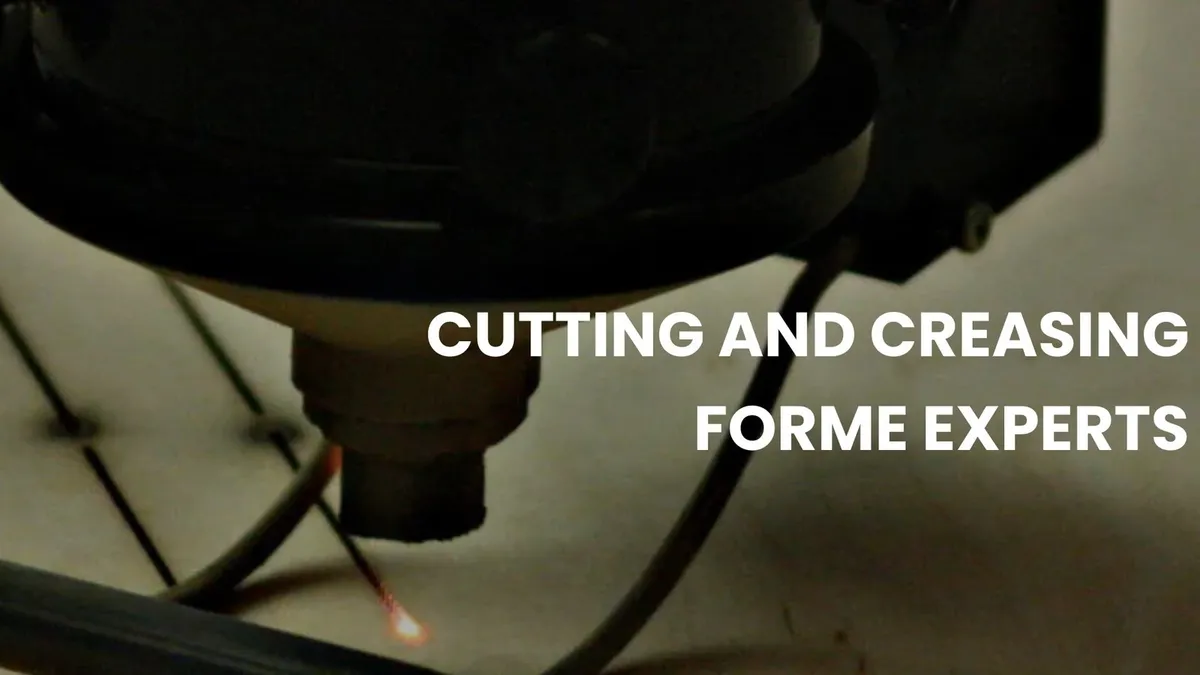
The slots in the forme board are laser cut, and Crosland are straightforward about the limits. Their lasers cut softer materials: wood to laser quality, polypropylenes, polycarbonates and nylon-type materials. They do not cut metal. MDF can be cut, but they decline to because the fumes fall foul of HSE regulations, which is the kind of detail that tells you something about how a supplier operates.
Their range runs well beyond packaging: gasket tooling in cork, felt and rubber for automotive and medical, foam cutters, vacuum forming blister pack cutters, point of sale display tooling in N flute, Foamex and magnetic materials, and jigsaw formes, which are bent by hand. For cartons they make full Bobst set dies and strippers, and their published materials list covers solid boards, PET, N flute and AAA flute, for presses including Bobst, Maramatsu, Eturna, Goldline, Cuir, Century and Varimatrex.
A die shop that spends its week cutting Kevlar, coffin board and jigsaw puzzles has seen more edge cases than one that only does cartons.
Turnaround is a lead time you can feel
Crosland publish an average turnaround of 48 to 72 hours, with specialist work such as jigsaw tooling running to six or eight weeks.
That number matters more than it looks. On a new packaging format, tooling is the step buyers assume is the bottleneck, and it usually is not: the design, the sample, the loaded test and the approval take longer than the tool. But when a promotion date is immovable, every day in the die shop is a day somebody is watching, and a supplier that turns formes in two or three days gives a programme room that a slower one does not.
A forme is an asset, like a plate
The same economics as printing plates. A forme is a one-off cost for a new design, retained and reused on every repeat run. The first order carries it and the rest do not, which is most of why unit price falls so steeply between a trial order and a production run.
And the same consequence: changing the design means new tooling. A crease moved by 2 mm is free on a sample and a new forme afterwards. Keeping that in mind is part of running a repeat programme properly, where the specification is locked precisely so that the tooling stays valid.
The die and the surface it cuts against
Our mailers, book wraps and trays are cut on a rotary die-cutter, where the tooling presses the board against an anvil cylinder. The die gets the attention and the surface it cuts into decides how long the cut stays clean, which is why we also wrote up the anvil covers from Policart.
Tooling, anvil, plate, ink, adhesive and board. None of it is visible in a finished box, and all of it decides whether the box is any good.
Send us the format and we will design it, cut a sample before any tooling is committed, and tell you what the forme costs and what the second order costs without it.