Three things decide what a printed corrugated box actually looks like. We have written about two of them: the ink that goes on, and the board it goes onto, which shifts every colour before the press has done anything.
The third is the plate, and it gets discussed least, usually because it appears on a quotation as a one-off line item and then never again.

Ours come from Brand Flex, the specialist flexographic platemaking division of Brand Imaging Solutions, a packaging and pre-media production agency working for printers and brands internationally. They are flexographic plate manufacturers rather than a general print supplier, which is the distinction that matters here.
What a plate actually is
A flexographic plate is a sheet of photopolymer carrying your artwork in relief. The raised areas pick up ink from the anilox roller and press it onto the board. Everything etched away sits below the printing surface and transfers nothing.
One plate per colour, per design. A two-colour box has two plates, each carrying the part of the artwork in its colour, and the press has to hold them in register with each other while board runs through at speed.
That is the whole mechanism, and it explains the thing that confuses buyers most: the plate is the only part of the print chain made specifically for them. The ink is a formulation anyone can order, the board is a stock grade, the press is the same press. The plate is the artwork made physical, and its quality sets a ceiling nothing downstream can lift.
What the plate controls
Solid ink density. Most trade packaging is solids: a logo, a panel, type, handling marks. How evenly a solid lays down over a fluted surface is a plate characteristic as much as an ink one, and it is where a well-made plate is most visibly worth the money.
Dot structure. Where artwork has tints rather than solids, the plate’s dot structure decides how cleanly they hold and how much they gain on an absorbent liner. Plate technology has moved a long way here, and Brand Flex supply conventional, HD and Full HD polymer plates, with the finer options aimed at work that needs closer-to-gravure detail.
Register between colours. Two plates have to agree with each other. Mounting accuracy and plate stability decide whether a second colour sits where the first one expects it, which is what separates a clean two-colour print from one with a visible fringe.
Durability over a run. A plate is a consumable that has to behave identically on the first case and the ten-thousandth. On long repeat programmes that consistency is the entire point.
Beyond plates
Platemaking sits inside a wider pre-press function, and Brand IMS’s published work shows the range of it: colour management and profiling, fixed palette work, press fingerprinting carried out on site, proofing for colour approval, in-the-round continuous printing sleeves for wide-format registration, and artwork retouching to match a client’s colour standards.
Most of that belongs to flexible packaging and higher colour counts rather than to two-colour post-print on corrugated. But the thinking behind it is the same thinking that produces a plate which prints a brand colour the same way in March and in November, which is what a repeat programme actually needs.
Press fingerprinting is the piece worth understanding even if you never buy it. It means characterising how a specific press, with a specific ink set, actually behaves on a specific substrate, and then building plates and profiles to suit that rather than to suit a theoretical standard. It is the industrial version of the argument we make about approving a drawdown on the actual board rather than matching to a Pantone chip.
Plates are an asset, not a charge
This is the commercially useful part, and it is routinely explained badly to end customers.
Plates are a one-off cost per colour per design. Once made, they are retained and reused on every repeat run of that artwork. The first order on a new design carries them; the second does not. It is the main reason the price per box falls so sharply between a first trial order and a production run, as our piece on what drives the unit price sets out.
Two practical consequences follow.
Artwork changes are not free. A logo tweak, a new barcode or an updated recycling mark means new plates for the affected colours. It is worth batching changes rather than making them one at a time, and it is why artwork version control belongs in the specification of a repeat programme rather than in somebody’s inbox.
Colour count is a capital decision, not just a running cost. Going from one colour to two adds a plate to every design in the range. For a range of twenty SKUs that is twenty plates, which is a different conversation from the per-box ink cost.
What we use them for
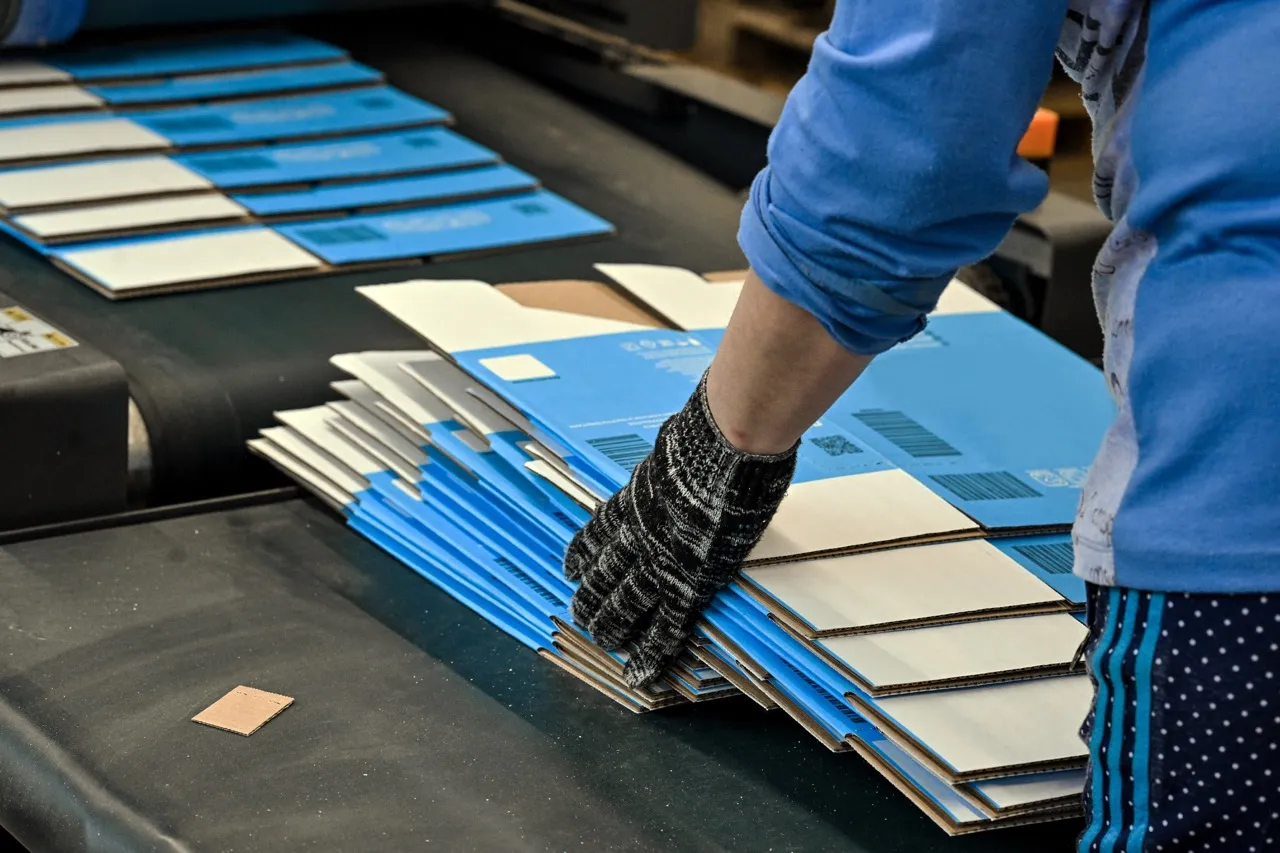
In house we print up to two colours of flexographic, water-based, applied inline on the same pass that cuts and creases the blank. That covers brand marks, type, pricing panels, barcodes and handling marks, which is what the overwhelming majority of trade packaging carries.
Where a job needs photographic artwork or full colour, digital print and litho-lamination run through our print partners instead, and our guide to print methods covers which is worth the difference at a given run length.
Why we write these up
A printed box is a system: the plate, the ink, the anilox, the board and the press all have to agree. When a brand colour comes back wrong, the instinct is to blame the ink, and the ink is rarely the problem on its own.
Knowing which part of that chain does what is what lets a distributor have a useful conversation with a brand customer instead of a defensive one. The same reason we wrote up our inks, our adhesive and the liner behind our peel and seal.
Send us the artwork and the format and we will tell you what it will cost in plates, what it will look like on the board you are buying, and what the second order will cost once the plates are made.